Rencore

GitHub Copilot
Rencore monitors GitHub Copilot across 16 governance policies, 3 reports, and 8 inventories, detecting unused seats, low adoption, and content exclusion gaps automatically.
GitHub Copilot is in private preview. Join the waiting list and we will reach out when access opens up.
Join the waiting listRencore GitHub Copilot governance is a set of 16 policies, 3 reports, 6 segments, and 8 inventories that audit GitHub Copilot seat assignments, daily usage metrics, language and editor usage, content exclusions, and organization settings. It detects seats assigned to inactive users, organizations with low adoption rates, and missing content exclusions for sensitive repositories.
43 governance capabilities: 8 inventories · 16 policies · 3 reports · 6 segments · 4 automations
Why govern GitHub Copilot with Rencore
-
Optimize seat utilization
Detect Copilot seats assigned to users inactive for 30+ days, seats for users deactivated in Entra ID, and organizations where actual usage is below the seat count. Reclaim wasted licenses.
-
Enforce content exclusions
Identify repositories missing content exclusion rules that prevent Copilot from processing sensitive codebases. Ensure intellectual property and regulated code stays out of AI suggestions.
-
Track adoption and productivity
Reports show daily suggestion acceptance rates, most active languages, editor distribution, and model usage per organization. Compare adoption across teams and repositories.
What Rencore discovers
Rencore automatically inventories these GitHub Copilot object types.
-
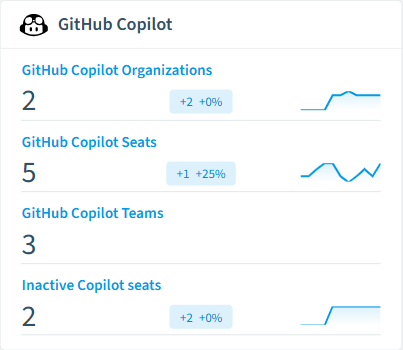
GitHub Copilot Organization
A GitHub organization that has GitHub Copilot Business or Enterprise enabled; the top-level container for seats, teams, metrics, and content exclusions.
-
GitHub Copilot Seat
A Copilot seat assignment; one per user granted access to Copilot in the organization.
-
GitHub Copilot Team
A GitHub team assigned Copilot seats in the organization.
-
GitHub Copilot Metrics Daily
Daily Copilot activity rollup at the organization level; active users, suggestions, acceptances, chat usage.
-
GitHub Copilot Language Usage
Copilot usage aggregated by programming language over the last 28 days.
-
GitHub Copilot Editor Usage
Copilot usage aggregated by editor (VS Code, JetBrains, Neovim, etc.) over the last 28 days.
How GitHub Copilot governance works in Rencore
Rencore connects to GitHub via the GitHub API and inventories Copilot seat assignments, daily usage metrics, language and editor breakdown, content exclusions, and organization-level settings. Policies run on each scan cycle and flag seat waste, adoption gaps, and security issues.
Who uses GitHub Copilot governance
Heads of IT use seat utilization policies to justify Copilot spend and recover unused licenses. CISOs enforce content exclusion policies to protect sensitive repositories. Engineering leads use adoption reports to identify teams that benefit most from AI-assisted coding.
Getting started
Provide Rencore with a GitHub Personal Access Token or App with organization admin scope. All 16 policies activate on first scan, covering seats, usage, and content exclusions automatically.
Policies
16 governance rules that detect violations and risks.
-
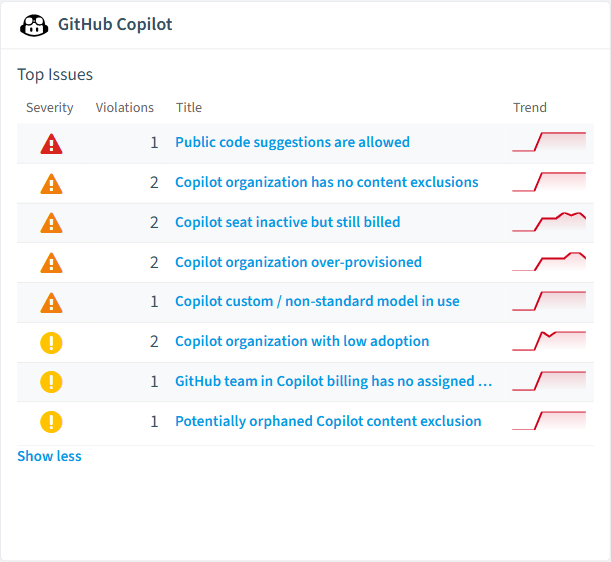
Public code suggestions are allowed
Detects Copilot organizations that permit suggestions matching public code.
High Security -
Copilot seat assigned to deactivated Entra ID user
Detects Copilot seats whose underlying Entra ID account is disabled.
Medium Security -
Copilot seat held by external guest user
Detects Copilot seats assigned to guests in the Entra ID tenant.
Medium Security -
Copilot organization has no content exclusions
Detects organizations with no Copilot content exclusion rules configured.
Medium Security -
Copilot seat inactive but still billed
Detects Copilot seats with no activity in the last 30 days.
Medium Costs -
Copilot organization over-provisioned
Detects organizations with more than 10 inactive Copilot seats in the current billing cycle.
Medium Costs
Need a rule that isn't listed? Rencore's Policy Builder lets you create custom policies tailored to your organization. Learn more about the Policy Builder
Reports
3 analytics views and dashboards.
-
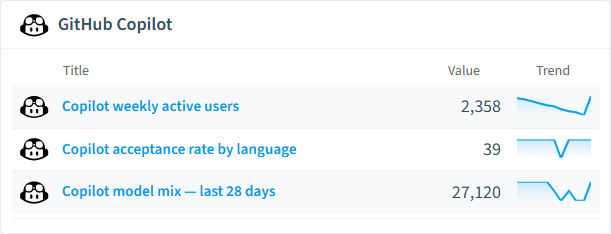
Copilot weekly active users
Weekly active Copilot users over the last year.
Line Chart · Operation
-
Copilot acceptance rate by language
Average suggestion acceptance rate across the top 10 most-used languages.
Bar Chart · Operation
-
Copilot model mix; last 28 days
Distribution of Copilot suggestions across AI models in the last 28 days.
Donut Chart · Operation
Automations
4 automated remediation workflows.
-
Remove Copilot Seat
Automatically removes a Copilot seat assignment from a GitHub organization after approval
-
Block Copilot Public Code Suggestions
Automatically configures a GitHub organization to block Copilot suggestions that match public code after approval
-
Delete Copilot Content Exclusion
Automatically deletes a Copilot content exclusion rule after approval
-
Remove Team from Copilot Billing
Automatically unassigns all Copilot seats granted via the specified GitHub team after approval
Segments
6 data groupings for targeted filtering.
-
Inactive Copilot seats
Copilot seats with no activity in the last 30 days.
-
Team-assigned Copilot seats
Seats granted via a GitHub team rather than an individual assignment.
-
Individually-assigned Copilot seats
Seats granted to specific GitHub users rather than teams.
-
Copilot seats pending cancellation
Seats scheduled for cancellation at the end of the current billing cycle.
-
Copilot custom model usage
Models outside the standard GPT / Claude / Gemini families; likely custom / BYOM.
-
Organizations allowing public code suggestions
Organizations configured to permit Copilot suggestions that match public code.
Frequently asked questions
Does Rencore support governance for AI tools beyond Microsoft Copilot?
What is Rencore governance?
How do Rencore policies work?
Trusted by